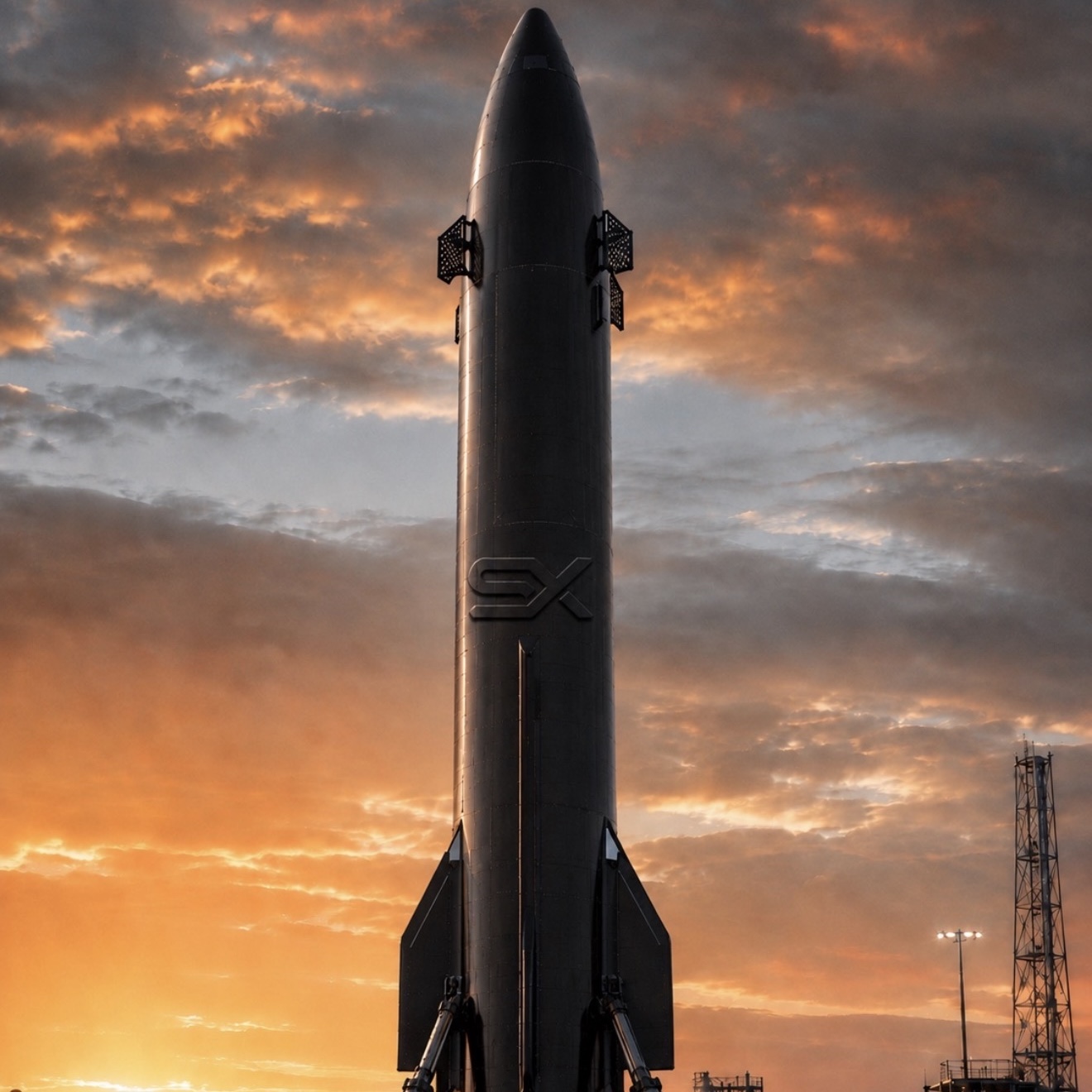
Magnetar
ConceptAerospaceMagnetar is an intelligent experimental launch vehicle designed around autonomous flight, precise stabilization, payload deployment, and controlled recovery. It combines propulsion, navigation, onboard sensing, adaptive flight control, and integrated safety systems into a unified platform built to manage every stage of a mission.
Built by Mantresh KhuranaMagnetar is an advanced aerospace project focused on creating a highly integrated launch vehicle capable of managing its flight from launch through ascent, mission operations, descent, and landing.
At the center of Magnetar is Kinesis, its dedicated motion and stability control system. Kinesis continuously evaluates the vehicle's movement and overall state, helping Magnetar maintain the correct orientation and respond to changing conditions throughout a flight.
Rather than treating navigation, propulsion, stabilization, landing, and vehicle monitoring as isolated systems, Magnetar brings them together into a coordinated control environment. Information from throughout the vehicle contributes to a continuously updated understanding of its condition, allowing its onboard systems to make informed adjustments as the mission progresses.
During ascent, Magnetar actively maintains stability and trajectory while monitoring the health of the vehicle. During periods where precise orientation is required, such as payload operations, the control system can maintain a stable attitude without relying entirely on propulsion.
Magnetar is also designed around controlled payload deployment. Its payload section remains integrated with the vehicle, allowing mission hardware to be deployed without unnecessarily discarding major structural components. Vehicle orientation and stability are monitored throughout the deployment sequence to help ensure that payload operations occur under suitable conditions.
For descent and landing, Magnetar coordinates its navigation, flight-control surfaces, propulsion, environmental awareness, and landing systems to progressively transition from flight into a controlled touchdown. The vehicle continually evaluates its orientation, altitude, motion, remaining resources, and landing conditions while approaching the ground.
A distributed sensing system provides Magnetar with awareness of the state of its major subsystems. Instead of relying on a single measurement, the vehicle can compare information from multiple sources to identify inconsistencies and improve confidence in its decisions.
Magnetar also incorporates AI-assisted vehicle monitoring, allowing its computers to evaluate whether different observations agree with one another. Unexpected readings can be compared against the broader state of the vehicle before they influence critical decisions, reducing dependence on any individual sensor.
Safety is treated as part of the overall flight architecture rather than as a separate feature. Magnetar continuously monitors for abnormal motion, subsystem failures, unexpected vehicle behavior, and conditions that could threaten the mission. When required, it can transition into predefined stabilization, shutdown, abort, or recovery behaviors.
The vehicle includes onboard visual monitoring and mission recording capabilities for navigation, inspection, mission verification, and post-flight analysis. Important flight events and vehicle-state information can remain recorded onboard even when communication with ground systems is interrupted.
Magnetar is also designed with maintainability in mind. Its internal systems are organized so that major components and sensing systems can be inspected, serviced, replaced, and upgraded without requiring extensive redesign of the entire vehicle.
Before launch, Magnetar performs a comprehensive readiness process covering its flight controls, propulsion systems, navigation, onboard computing, communications, sensing, payload systems, power systems, and recovery hardware. Critical inconsistencies can prevent the launch sequence from proceeding.
Ultimately, Magnetar is being developed as an integrated intelligent launch platform rather than simply a rocket. Its goal is to combine autonomous decision-making, vehicle awareness, precise motion control, payload capability, safety, and recoverability into a single coordinated aerospace system capable of managing an entire mission from liftoff to landing.
The team
Developers
The people who build and maintain this project. Every contribution here is credited on their GitHub profile too.
Discussion
Questions and feedback on Magnetar.
Loading…